Johanna Hedva
George R. Miller
Andrew Mangold music
residency at Casa Mahler
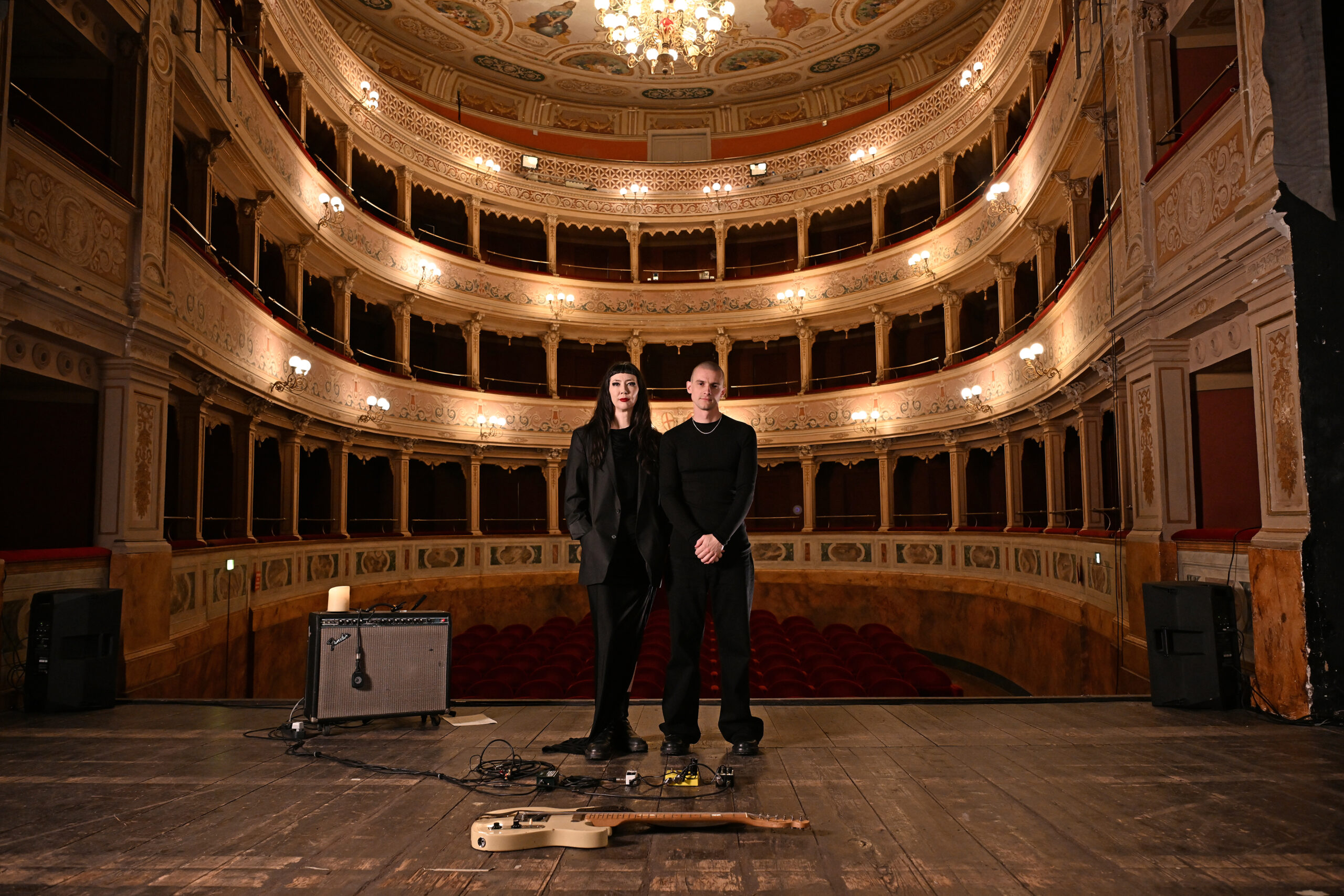
Artist Johanna Hedva and director George R. Miller were awarded the Andrew Mangold music residency at Casa Mahler to develop a new work which will be premiered in fall 2026, and toured in 2027. A recent staging of it co-headlined the Creamcake Festival at the HAU Theater in Berlin, to a sold-out crowd in October.
The residency is organised in memory of composer and musician Andrew Mangold (1971-2021). The selection committee was led by Duval Timothy and Mathias Kawinek.
Hedva is a Korean-American writer, artist and musician whose influential work questions how we encounter illness, disability, doom, and death. Suffused with hermetic and philosophical references and methods, their practice spans critical writing, fiction, music, performance, and visual art. Hedva’s recent performance and album ‘Black Moon Lilith in Pisces in the 4th House’ blended doom-metal guitar with Korean P’ansori singing. Hedva is also trained in classical opera from the European tradition. Their new work will juxtapose these antipodal singing styles: the classical operatic voice with the ‘broken’ voice cultivated and controlled in P’ansori training as a reflection of emotional struggle and cathartic emotion.
The work developed at the Mahler & LeWitt Studios will be realised as a multi-disciplinary performance for both theater and exhibition spaces. It will combine a new cycle of songs, a play, and staging elements (light, costume, set, sculpture, and installation). Hedva writes:
“The songs use melody, style, content, and structures I’ve never used before. They tell a story, beginning to end, that excavates themes of desire, power, pain, and fragility. It’s midnight. It sounds like a succubus singing folk songs. These are dominatrix blues. There are demons to be exorcised. Maybe I am the demon. The songs are blunt, wild, big—but they were written on a haunted acoustic parlor guitar, which is small, and can sound thin. The guitar is haunted. It disappeared for ten years and then returned. What this requires of me to play is new: I’ve never sung this way before, never played this way before, and never been directed by a collaborator before. As new as all of this is, it is a natural development in my work as a musician, songwriter, performer. I am trying to devote myself to bringing this into the world the way it deserves, and this residency would allow me to do that in a total way.
“Alongside these songs is a new play that envisions a character named Johanna Hedva, delivering a monologue in a space that may or may not be the afterlife. The stage around Hedva is eerie and bare, with two silent attendants dressed in white pushing a grand piano back and forth across the stage. Black feathers fall out of the piano continuously, accumulating and swirling around the feet of the attendants. A mattress hangs parallel to the stage, just above my head and out of reach. It glows, becoming an otherworldly light source. “Hedva” keeps falling down and getting back up again. They sing, laugh, and cry. They croak, growl, and scream. There are explicit references to Ovid’s Metamorphoses, Romeo Castellucci, Rebecca Horn, and Nine Inch Nails. What feels like 50 years pass.”
The new performance will be Hedva’s most ambitious to date and will be developed in collaboration with the opera director George R. Miller. Miller has presented work at Carnegie Hall, Opera Philadelphia, The Juilliard School, REDCAT, Long Beach Opera, Opera Saratoga, Los Angeles Chamber Orchestra, Pioneer Works, Pageant, and Wild Up among others. He was a lead Producer for the Performa23 Biennial in New York City, where he developed work with artists Nikita Gale, Teo Ala-Ruona, KMRU, and Alexa West.
Johanna Hedva (b. 1984, Los Angeles, CA, USA; lives and works in LA, USA) Across critical writing, fiction, music, performance, and visual art, their work deals with ecstasy as much as abjection; erotics as much as disintegration; death, illness, and disability, as much as mysticism, ritual, and political activism. They have cited the influence of Korean shamanism, as well as Diamanda Galás, Keiji Haino, and Sainkho Namtchylak on their music, but particularly Korean Pansori singing, where contrary to established Western criteria, signs of vocal damage are not seen as evidence of the voice or performer ‘losing’ something but rather evidence of what the performer has gained. This sentiment informs their visual practice, too, insisting on an aesthetic that foregrounds the body as it moves through time and is marked and transformed by that process. Hedva sees the body not as a passive intermediary that separates the self and the world but an agential convergence; a body that bears the marks of struggle, of life, of the domination and oppression in our world, but one also constitutive of other realities, other systems of value and meaning, a broker of new forms of knowledge. Their work asks what power is reclaimed when a person commands the fate of their own materiality, and what happens politically, aesthetically, and conceptually when a body surrenders to fates larger than itself. For Hedva, bringing this reversal into the space of art and cultural institutions is to challenge ableist imperialisms that are endemic to such institutions. Far from just a symbolic gesture, situating the politics of negation so viscerally in their own body, they enact a rebellion of kinked pleasure. They are the author of four books, including the 2018 novel On Hell, and Minerva the Miscarriage of the Brain, a collection of poetry, plays, and essays published in 2020. More recently, their 2023 novel Your Love Is Not Good was longlisted for the Republic of Consciousness Prize, and their 2024 essay collection, How To Tell When We Will Die: On Pain, Disability, and Doom, won the Amber Hollibaugh Award for LGBTQ+ Social Justice Writing. Hedva’s most recent solo exhibitions include Genital Discomfort, TINA, London, 2024; If You’re Reading This, I’m Already Dead, JOAN, Los Angeles, CA (2023); Who Listens and Learns, Modern Art Oxford, Oxford (2022); Glut (A Superabundance of Nothing), Shape, UK (2021); God Is an Asphyxiating Black Sauce, Klosterruine, Berlin (2020); Reading Is Yielding, parrhesiades, London (2019); and Everything Is Erotic Therefore Everything is Exhausting, PØST, Los Angeles, CA (2011). (Bio text from TINA gallery — more info here). Artist website
George R. Miller is an opera director. He creates sensorially rich, emotionally precise worlds that reckon with history, power, body, and voice through sound, text, image, and action. As both a director and producer, Miller is dedicated to platforming and reimagining canonical repertoire as well as championing and developing newly created works. With a background in music composition and visual art, his multidisciplinary, site-responsive approach seeks to bring new life to classical forms. His productions have been called “stunning” (LA Dance Chronicle), “superbly directed” (San Francisco Classical Voice), “coalescing into one undeniable impact” (San Francisco Classical Voice). This season, George made both his European and Carnegie Hall debuts. At Carnegie, he staged a pairing of Symphony No. 3 by Philip Glass and the world premiere of Cloud Variations by poet J. Mae Barizo, marking their second collaboration, this time with The Knights Orchestra in Zankel Hall. In Europe, he directed writer, musician, and performance artist Johanna Hedva in a new work at Berlin’s Hebbel am Ufer (HAU2). He has been a regular guest artist with the opera program at the University of California Los Angeles, where he served as associate director for a new production of Britten’s The Turn of the Screw and directed a fully staged evening of Mozart scenes with the UCLA Philharmonia Orchestra in the Herb Alpert School of Music’s Schoenberg Hall. In April he will direct soprano Kerrigan Bigelow (Metropolitan Opera Laffont Competition Regional Finalist) in her M.M. recital at The Juilliard School, presenting La Voix Humaine by Francis Poulenc and Jean Cocteau with Juilliard DMA pianist Amber Scherer. Recently, George opened Long Beach Opera’s season to high acclaim with the world premiere of ISOLA, a monodrama by composer Alyssa Weinberg and poet J. Mae Barizo, featuring soprano Ariadne Greif and dancer–choreographer Julia Eichten. He is currently developing a new production of Schubert’s Winterreise with bass-baritone William Socolof, a staging of Kaija Saariaho’s Quatre Instants with soprano Nicoletta Berry, and an adaptation of Sieben Frühe Lieder by Alban Berg with composer-performers Eliza Bagg and Rohan Chander, which premiered at REDCAT’s 2024 NOW Festival. Of that production, LA Dance Review noted, “Every detail seemed carefully staged, from the slide of Bagg’s hand against her skin to her gaze shifting in and out of focus, lending purpose and clarity to each moment.” In spring 2025, George joined the Manhattan School of Music as a guest director to lead Handel’s Rinaldo with the Graduate Vocal Arts Division, resetting the absurd baroque comedy as a WWE wrestling match. Voce Di Mache, the notorious blog critic of NYC student productions, wrote: “Miller’s work doesn’t speak, it screams… No wonder the young cast and young audience enjoy it so much.” He has been a guest speaker at Vanderbilt University, The Manhattan School of Music, The New School, and Coaxial Arts Foundation. Artist website
Andrew Mangold music residency at Casa Mahler Classically trained at the Manhattan School of Music, New York City, and the University of Music and Performing Arts Vienna, Andrew Mangold was a multi-instrumentalist who composed extensively, from orchestra to solo piano. His work was particularly informed by his love of poetry and the work of Shostakovich. Latterly, playing guitar and on vocals, he composed songs and wrote lyrics for his bands The Pet Goats and Berufskleidung. Their work was inspired by the Hamburger Schule and Proto-punk movements, incorporating Noise and Post-rock elements. The residency opportunity in Spoleto, generously supported by Andrew’s family, is open to artists of all genres whose work pushes the boundaries of contemporary music and speaks to the most pressing issues of our time.