Sculpture Speaks
Louder Than Words
– Barry Flanagan
Musei Civici di Spoleto, Palazzo Collicola
Schools and Public Program
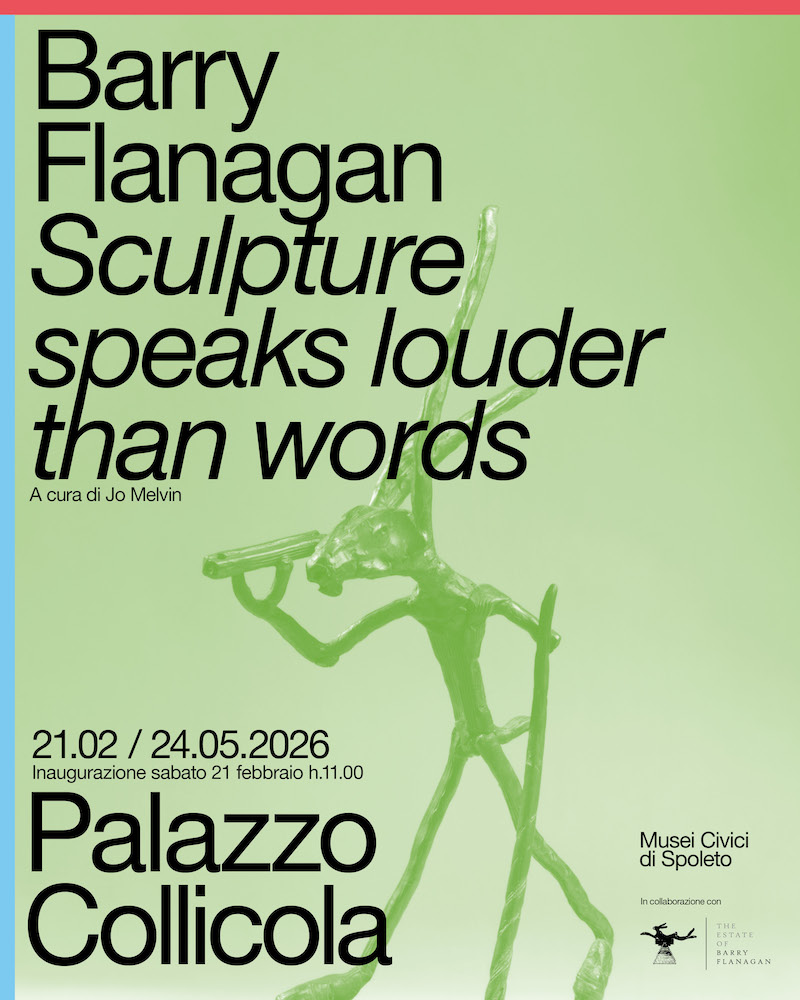
Opening: February 21, Palazzo Collicola
Events: Sunday 22 February and Saturday 18 April
Public Program
James Cave
Adelaide Cioni
Toby Christian
Gertrude Gibbons
Jo Melvin
Schools Program
led by Giulia Filippi
Liceo Artistico di Spoleto
Accademia di Belle Arti di Perugia
We are pleased to present a program for schools and the public alongside the exhibition ‘Sculpture Speaks Louder Than Words – Barry Flanagan’ at Palazzo Collicola, curated by Mahler & LeWitt Studios alumna Jo Melvin and supported by the artist’s estate.
Barry Flanagan (1941–2009) was one of Britain’s most inventive and original sculptors. He challenged formalist approaches and opened sculpture to new materials and ideas. The exhibition at Palazzo Collicola focuses on his early work and explores how the artist considered sound and silence as essential sculptural elements, as fundamental to his practice as weight and volume.
Sunday, 22 February
Palazzo Collicola, 11:00–11.45
Jo Melvin, ‘Sculpture Speaks Louder Than Words’
Tour of the exhibition with the curator Jo Melvin.
Sala Pegasus, 12:00–12.45
Gertrude Gibbons/Jo Melvin: ‘Where is my voice?’, with Barry Flanagan’s ‘O for orange U for you: poem for the lips’
A short film exploring aphasia, from the perspectives of both speaker and listener, followed by a recording of Flanagan’s experimental poem: both works highlight the vicissitudes of language and explore alternative modes of expression.
Saturday, 18 April
Palazzo Collicola, 16:00–16.45
Toby Christian – flamespeak
Shadows coalesce with text and speech in this new performance exploring the fragility of the printed word. Presented with the collaboration of students from the Accademia Belle Arti Perugia.
Sala Pegasus, 17:00–17.30
Adelaide Cioni – Bla Bla Bla
An exploration of language and visuality: “A performance lecture on infinity or, a bunch of questions with impossible answers, revolving around patterns, translation and the human condition (and yes, thank god there will be pictures).”
Casa Mahler (Via degli Eremiti 7), 18:00–20:00
James Cave – The Desert Hills Fan Out Like Playing Cards
In this performance for piano and field recordings (gathered by Nyla Van Ingen), Cave imagines Spoleto as a place filled with sonic ghosts from different musical eras and parlays with historical figures through the language of music.
With the participation of students from the Mahler & LeWitt Studios schools program led by Giulia Filippi:
Francesca Biancalana
Maria Furno
Asimenia Galani
Anna Serena De Gaspari
Michele Pangrazi
Barry Flanagan trained at St Martins School of Art, London, in the 1960s, alongside artists such as Richard Long, Bruce McLean, Tess Jaray and Gilbert & George. The exhibition ‘Sculpture Speaks Louder Than Words’ explores Flanagan’s experiments with everyday materials – such as builders’ sand, quayside rope, and cloth – as well as with light and language, often in performative situations. Influenced by both Minimalism and Arte Povera, he explored repetition and process in dialogue with the senses: where smell, touch and the “sound of making” become part of the sculpture itself. Discussing the impact of Flanagan’s work, the curator Jo Melvin writes:
Within Flanagan’s explorations of language and material, to have his sculptures speak to society was vital. His commitment to the relationship between art, society and institutional responsibility informed his intentions to making and showing work. In Germano Celant’s book Arte Povera (1969), Flanagan writes, ‘Operations grow from the sculptural premise, its exactness and independence is the clue to the scale of its physical, visual and actual consequence in society’. Flanagan’s concern is with the language of poetry in sculpture, the mysterious relationship between minerals, materials and making, and how this spoke to society and the landscape.
The schools program is led by artist and educator Giulia Filippi and is developed in collaboration with the Liceo Artistico di Spoleto and the Accademia Belle Arti Perugia: students will participate in the installation of the exhibition and contribute to performance events within the public program, while also engaging in meetings with curators, studio visits with contributing artists, and portfolio reviews.
The public program was conceived by Gertrude Gibbons, Jo Melvin, and Guy Robertson.
Events:
Jo Melvin, ‘Sculpture Speaks Louder Than Words’
22 February, Palazzo Collicola, 11:00–11.45
Tour of the exhibition with the curator Jo Melvin.
Jo Melvin is Professor in Fine Art and Feminisms at Chelsea College of Arts, UAL, London, and was Director of the Barry Flanagan Estate from 2009-2023. She is a writer and exhibition maker, with an interdisciplinary research methodology giving attention to practices of women by using ‘forgotten histories’ (archives, memory, oral histories) as material for new curatorial research. Recent projects include ‘Speak Out, Out there’, an exhibition with Jeff Gibbons at The House Dublin (2023), ‘Pataphysics and Play’ at Kasmin Gallery New York (2023), ‘The Feuilleton I will bear witness: Piggy-backing from the Edicola’, Spoleto, Umbria and MACRO, Roma, Italy (2021), ‘Imagine Being Here Now’ with Lucy R. Lippard and Askeaton Contemporary, (2021)/ In 2018 Melvin started collaborating with Vittoria Bonifati to form a series of exhibitions, publications and events at Villa Lontana, Rome.
Gertude Gibbons and Jo Melvin: ‘Where is my voice?’, with Barry Flanagan’s ‘O for orange U for you: poem for the lips’
22 February, Sala Pegasus, 12:00–12.45
This short film (16mins), a collaboration between mother and daughter, reflects on the experience of aphasia. We explore the language disorder from the perspective of ‘both sides’; the one who has the condition and the one who listens. The film demonstrates their methods of communication and the (re)interpretation of verbal/grammatical ‘mistakes’. It makes reference to various works of art, literature and music which directly or indirectly speak to the experience of aphasia. The film refers to the work of several writers, composers and artists, including the artist Barry Flanagan, whose treatment of sound, silence and sculpture is resonant. The screening is followed by a recording of a 2021 performance by Melvin with Adelaide Cioni of Flanagan’s poem ‘O for orange U for you: poem for the lips’ (1965), which silently mouths vowels, making them seem both very physical and intangible. Gibbons writes: “We propose that art, in all its forms, offers alternative modes of communication and expression, giving voice in unconventional ways, and how approaching the arts as a vehicle in this way can facilitate new approaches to thinking about language.”
Gertrude Gibbons is a writer and PhD candidate at the University of York (AHRC funded through the White Rose College of the Arts & Humanities), researching a history of theatre-making centred on the search for a shared language of theatre from the 1960s onwards. This year she is curating an event at the York International Shakespeare Festival on the documentation of performance, translation and music. She has a Master’s from the Royal College of Art and previously assisted on short courses, masterclasses and summer schools in their Executive Education department. She has an interdisciplinary creative critical writing practice and since 2018 has been co-editing online arts magazine Soanyway.
Toby Christian: flamespeak
18 April, Palazzo Collicola, 16:00–16.45
Christian presents his new performance work flamespeak, exploring the delicacy of the printed word and the malleability of the ground that anchors it. Projecting onto structures and surfaces of Palazzo Collicola, flamespeak sees text, shadow and speech coalesce, where quivering flames transmit multiple indefinite voices, for a new collaborative incantation.
Toby Christian’s interdisciplinary practice centres around objects and language to question prevailing modes of representation and communication via dissociative and divinatory processes. Working across writing and sculpture, his work has been exhibited, published, and presented at major institutions and platforms internationally. Recently these include Museum Tinguely, Basel; Institute of Contemporary Arts, London; NTS Radio; This Long Century; Parrhesiades, London; Galerija Prozori, Zagreb; PEER, London; MUDAM, Luxembourg; Whitechapel Gallery, London; Galeries Poirel, Nancy. His books Measures (2013), Collar (2017) and Commuters (2021) are published by Koenig Books, who will publish Stone, String, Word, a forthcoming monograph of his work. He is represented by Belmacz, London.Adelaide Cioni – Bla Bla Bla“A performance lecture on infinity or, a bunch of questions with impossible answers, revolving around patterns, translation and the human condition (and yes, thank god there will be pictures).”
Adelaide Cioni: Bla Bla Bla
18 April, Sala Pegasus, 17:00–17.30
Spoleto-based artist Adelaide Cioni explores language and visuality in Bla Bla Bla: “A performance lecture on infinity or, a bunch of questions with impossible answers, revolving around patterns, translation and the human condition (and yes, thank god there will be pictures).”
Adelaide Cioni (1976, Bologna, IT) studied drawing at UCLA, Los Angeles, and has a BA in Sculpture from the Academy of Fine Arts in Rome. With an MA in contemporary history and a master’s degree in Literary Translation, for ten years she translated American literature (John Cheever, Lydia Davis, David Foster Wallace, amongst others). In 2012 she started her artistic practice by exploring the intersection between textile, painting, and performance. An absence of narration and a feminist viewpoint drive her practice. In the last years she has connected her multidisciplinary research with music and dance. Amongst her recent solo shows: True Form, The Approach, London, UK; Drawings for Myself, P420, Bologna, IT; Il mondo, Centro Pecci Commission, Prato, IT, Ab ovo / On Patterns, Mimosa House, London, UK. She lives and works between Spoleto and London.
James Cave: The Desert Hills Fan Out Like Playing Cards
18 April, Casa Mahler (Via degli Eremiti 7), 18:00–20:00
The Desert Hills Fan Out Like Playing Cards by James Cave, with field recordings by Nyla van Ingen, is a 28-minute sound work which imagines Spoleto as a place filled with sonic ghosts from different eras. Cave stages multiple imaginary vignettes in which particular musical figures, from Mahler to Menotti, interact with locations in the city. He parlays with these characters, blending their musical styles with his own compositional voice. His approach has a quality of saudade: a Portuguese concept referring to a nostalgic longing for a specific time and place. Through its hybrid form, the piece offers an ironic and reflective commentary on musical history.
James Cave is a York-based composer, singer and instrumentalist. He was Composer-in-Residence at the Banff Centre, Canada (2015), and the first Composer-in-Residence at the Mahler & LeWitt Studios in Spoleto (2016). His work ‘The Desert Hills Fan Out Like Playing Cards’ was commissioned by Jo Melvin for the Edicola project in Spoleto and Rome (2021). Cave sings with York Minster Choir, Il Cor Tristo, and the choirs of York Oratory and Sheffield Cathedrals, and has toured internationally with the Gavin Bryars Ensemble. He has performed on BBC Radio 3 and NPO Radio 4, and has received the Terry Holmes Award, the Sir Jack Lyons Celebration Award, and ‘Best Use of Sound’ at ICAD. His music has been performed across Europe and North America and supported by organisations including AHRC, Arts Council and PRS. His first opera, Returns, is in development with director Rosalind Parker. He holds a PhD in Composition from the University of York, where he now lectures.
SCHOOLS PROGRAM
Giulia Filippi is a visual artist and researcher in the field of education. After studying visual art in Venice (IT) and Lahti (FIN), she attended a master in sociology and botany in Florence (IT). Since 2006, she works with different institutions to expand the educational program using the art practice to create connections to knowledge through experience. Among these: Peggy Guggenheim Collection, Viaindustriae, La Galleria Nazionale (Rome), ICA Boston, La Biennale di Venezia, Cittadellarte – Fondazione Pistoletto, OVS spa, WWF Italia, Fondazione Marino Golinelli, Studio Orta, Raumars, Felcos Umbria, Istituto Europeo Design, Rauma Art Museum (FIN), Bjcem (Thessaloniki, GR), Bivy Gallery (Anchorage, AK), Cooperativa Densa, Palazzo Lucarini and many schools of all levels.